
Elijah Under the Broom Tree: How God Cares for Those at the Limit of Exhaustion
Bible study on 1 Kings 19:4-8 about burnout and God's practical care: why the Lord offers sleep, bread, and quiet presence before asking for new steps of faith.
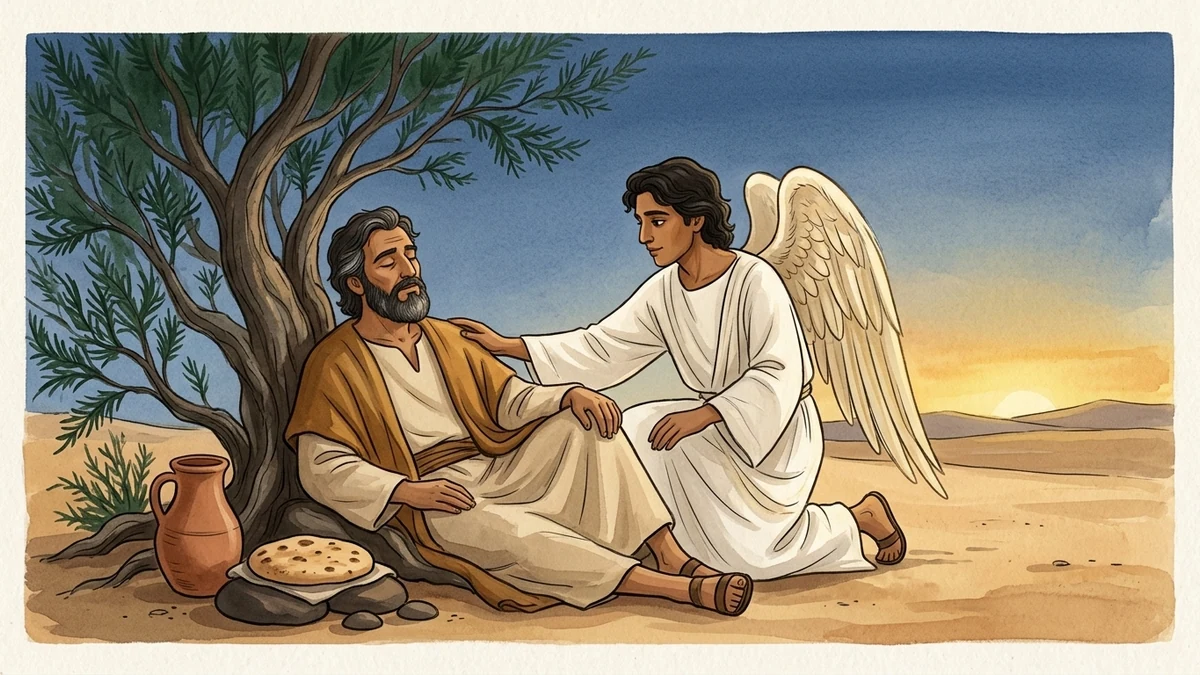
“while he himself traveled on a day’s journey into the wilderness. He sat down under a broom tree and prayed that he might die. “I have had enough, LORD,” he said. “Take my life, for I am no better than my fathers.” Then he lay down under the broom tree and fell asleep. Suddenly an angel touched him and said, “Get up and eat.” And he looked around, and there by his head was a cake of bread baked over hot coals, and a jar of water. So he ate and drank and lay down again. A second time the angel of the LORD returned and touched him, saying, “Get up and eat, or the journey will be too much for you.” So he got up and ate and drank. And strengthened by that food, he walked forty days and forty nights until he reached Horeb, the mountain of God.”, 1 Kings 19:4-8 (Berean Standard Bible, BSB)
From a distance, it is easy to assume that severe burnout only happens to people with weak faith or poor discipline. Elijah’s story in 1 Kings 19:4-8 overturns that assumption on the very first line. Hours before asking to die beneath a desert shrub, Elijah had confronted hundreds of Baal’s prophets on Mount Carmel, prayed down fire from heaven, witnessed the end of a three-and-a-half-year drought, and outrun King Ahab’s chariot through pouring rain.
The collapse did not follow defeat; it arrived right after the greatest triumph of his ministry. Once months of intense strain ended and Elijah saw that Jezebel’s threat remained intact (19:2), whatever remained of his physical and emotional reserves gave out. Inside any family, that same pattern repeats: after nursing a sick relative, surviving months of financial tension, or working nonstop without margin, someone suddenly hits a wall and feels unable to take one more step.
Running into the wilderness and praying from empty
Frightened by Jezebel’s message, Elijah flees south to Beersheba, leaves his servant behind, and walks alone a full day into the wilderness. Isolation is often the earliest sign of deep burnout: when we lack the energy to explain what hurts, we pull away even from people who want to help.
Sitting in the thin shade of a broom tree, the prophet prays one of the most candid prayers in the Old Testament: “I have had enough, LORD. Take my life, for I am no better than my fathers.” Elijah was worn down to the point of wanting life to end, convinced that all his prophetic labor had failed just like previous generations. Yet notice one crucial detail: he still speaks to the Lord. Even at rock bottom, he does not sever conversation with God.
Sleep: warm bread: and the absence of lectures
God’s response in 1 Kings 19:5-7 stands among the tenderest scenes in Scripture. The angel of the Lord does not wake Elijah with a theological reprimand about courage, nor hand him a five-point strategy to confront Jezebel the next morning.
Instead, God tends first to the exhausted body. Elijah falls into deep sleep under the tree. When the angel touches him the first time, there is no long speech, only two practical words: “Get up and eat.” Beside his head lay bread baked over hot coals and a jar of water. He eats, drinks, and goes right back to sleep. Hours later, the angel wakes him a second time with the same simple provision and a gracious explanation: “Get up and eat, or the journey will be too much for you.”
That sequence reveals something vital about how God made us. Human beings are an integrated whole of body and soul. When someone sleeps poorly for weeks, skips meals, and carries chronic stress, emotions lose balance and spiritual perception grows foggy. God never separates spiritual renewal from basic care for sleep and food. Before correcting the prophet’s perspective, the Lord feeds the tired man.
The walk to Horeb and the question in the cave
Strengthened by that meal, Elijah walks forty days and forty nights to Horeb, also known as Sinai, the mountain where Moses had received the Law centuries earlier. Only there, once rested and nourished, does the deeper conversation about his calling take place:
“There Elijah entered a cave and spent the night. And the word of the LORD came to him, saying, “What are you doing here, Elijah?””, 1 Kings 19:9 (Berean Standard Bible, BSB)
The order of events in 1 Kings 19 offers wise guidance for spouses, parents, and friends. We are often eager to jump straight to verse 9 (“Why are you sitting idle in this cave?”), demanding energy from someone still lying on the desert floor of verse 5. God moves in the opposite order: first He provides shade, sleep, and a warm meal; only afterward, when breath returns, does He listen to the prophet’s complaints and reveal that seven thousand faithful people still remain in Israel alongside new work ahead.
Practical care when burnout reaches your household
If you or someone close to you is walking through extreme exhaustion today, 1 Kings 19 points to concrete, compassionate habits:
- Honor physical limits without spiritual guilt: Sleeping, stepping into quiet for a day, and eating unhurried meals are not signs of laziness or weak faith. In Elijah’s wilderness, rest was the very instrument God used to preserve the journey.
- Trade pressure for tangible care: When a spouse or child is depleted, resist demanding instant cheerfulness. Cook a meal, take over a heavy household chore, and protect real hours of sleep before discussing major decisions.
- Avoid permanent decisions in the valley of fatigue: Under severe exhaustion, every road looks permanent and hopeless. Like Elijah, postpone drastic choices about marriage, career, or ministry until rest restores clarity.
- Welcome medical and pastoral support: God sent an angel in the wilderness to care for Elijah’s body; today He also works through doctors, Christian counselors, and mature friends in the church. Walking alone for months only deepens the cave.
Questions for reflection
- Can you recognize early warning signs before reaching Elijah’s point of collapse, or do you tend to push at full speed until your body shuts down?
- When someone at home is emotionally spent, what has been your family’s most common reaction: demanding more effort or offering rest and practical care?
- What “journey ahead” might God be preparing that requires you today to slow down, sleep better, and let others help carry the daily load?
Frequently Asked Questions (FAQ)
Why did Elijah experience burnout right after the victory on Mount Carmel?
Chapter 18 shows Elijah enduring tremendous spiritual and physical strain, followed immediately by Jezebel's death threat in 1 Kings 19:2. Severe burnout often hits right after prolonged pressure, when adrenaline drops and expected change fails to arrive.
What does the angel's care with bread and water in 1 Kings 19:5-7 teach families today?
It shows that body and soul are inseparable before God. Before speaking with Elijah about his calling in the cave at Horeb (v. 9), the Lord provides sleep, water, and warm bread. Protecting physical rest for an exhausted loved one is deeply spiritual care.
What does the warning 'or the journey will be too much for you' mean in 1 Kings 19:7?
The Lord acknowledges that the road ahead exceeds the prophet's depleted reserves. God never demands that Elijah march forward on empty; He supplies the strength required to reach Horeb and receive fresh direction.