
For the Vision Awaits an Appointed Time: Though It Lingers, Wait for It
In-depth Bible study on Habakkuk 2:2-3 about waiting for God's appointed time. Historical context, exegesis, and practical wisdom for family life.
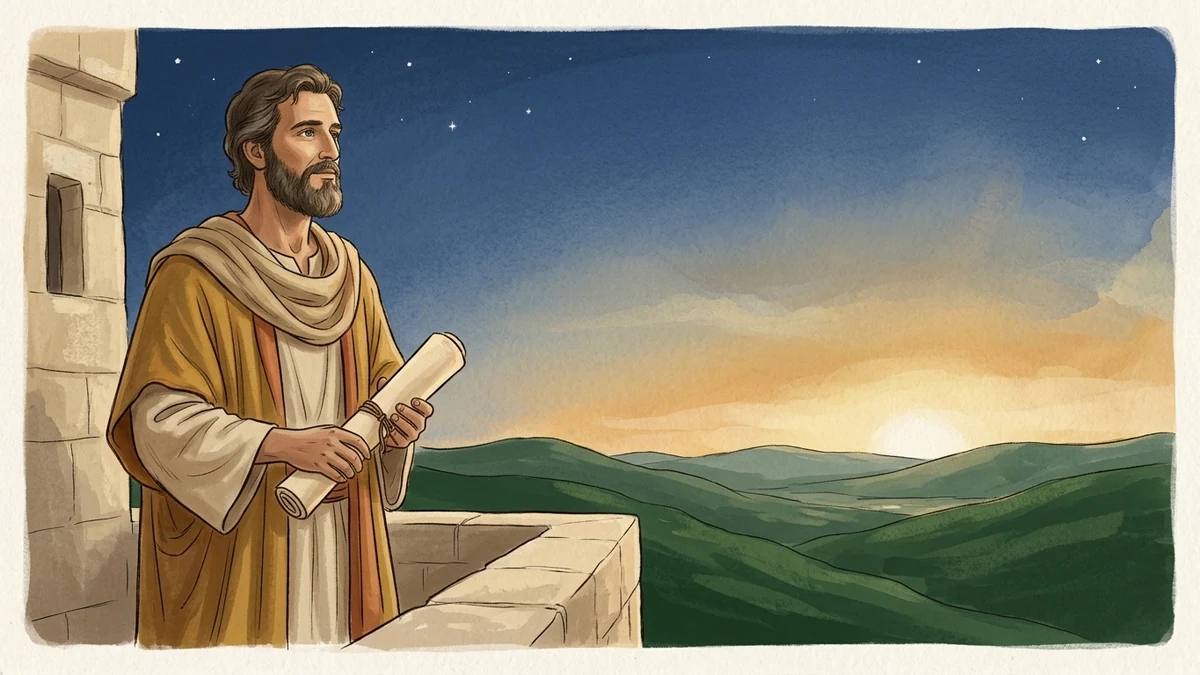
“Then the LORD answered me: “Write down this vision and clearly inscribe it on tablets, so that a herald may run with it. For the vision awaits an appointed time; it testifies of the end and does not lie. Though it lingers, wait for it, since it will surely come and will not delay.”, Habakkuk 2:2-3 (Berean Standard Bible, BSB)
Every household carries an invisible list of prayers that still have no visible answer. Some involve pressing practical needs, like an employment door that stays shut or a health struggle that drags on month after month. Others touch deeper, slower wounds: a marriage that needs patient rebuilding, a child who has drifted from the faith, or a promise that once felt vivid and now feels buried under years of ordinary routine.
As months turn into years and little changes on the surface, a distinct weariness settles in. It is rarely outright unbelief. More often, it is the quiet ache that makes a husband or wife wonder whether they misheard God, or whether their request has been left behind. By our human clock, the answer looks overdue. Anxiety urges us to take a shortcut, and exhaustion slowly cools the warmth of prayer around the table.
It is in that tense space between promise and fulfillment that the book of Habakkuk meets our family today. This 35-minute study invites you to climb the watchtower beside the prophet, understand the historical weight of Habakkuk 2:2-3, and discover how biblical faith sustains a whole home while God’s answer is still maturing out of sight.
The weight of delay inside the home
In everyday family life, the feeling that a promise is running late rarely stays tucked inside a private devotional journal. It spills into kitchen conversations, sharpens our tone in traffic, steals sleep at midnight, and colors how we handle minor frustrations. When we have waited a long time for a breakthrough, every small delay in the day seems to confirm that nothing is moving forward.
There is also a subtle guilt that creeps into Christian homes. Many believers assume that if their faith were stronger, waiting would not hurt so much. So they hide their questions, shrink their prayers down to polite formulas, and carry disappointment in silence. Others swing to the opposite extreme and try to force outcomes through impulsive choices, sudden career shifts, or financial commitments beyond their reach, all to manufacture the feeling of progress.
Habakkuk reveals a far healthier biblical path. The prophet did not pretend to feel calm when God’s silence and methods confused him. Instead, he brought his honest questions straight to the Lord and stood waiting for a reply. Out of that candid dialogue came the revelation of Habakkuk 2:2-3, offering real steadiness without minimizing the ache of waiting.
On the watchtower: the historical setting of Habakkuk 2
Habakkuk prophesied in Judah near the end of the seventh century BC, a season marked by political instability, domestic corruption, and rising military threat. The southern kingdom was sliding into moral decay after the death of King Josiah, while the Babylonian empire was sweeping across the Near East.
The book opens in chapter 1 with a blunt lament from the prophet. Habakkuk looks at his own nation and sees violence, twisted courts, and disregard for God’s law. He asks how long he must cry out before the Lord intervenes. God’s answer shocks him even more: the Lord declares that He is raising up the Chaldeans (Babylonians), a fierce and ruthless nation, to bring judgment upon Judah.
Deeply troubled, Habakkuk brings a second complaint. How can a holy God, whose eyes are too pure to look on evil, use a cruel, idolatrous empire to punish people who, for all their faults, are still more righteous than the invaders? After laying out his perplexity with reverence and candor, the prophet makes a deliberate decision in the first verse of chapter 2: he climbs to his watchtower, stations himself on the ramparts, and watches to see what the Lord will answer.
That image of the watchman on the city wall is essential for reading verses 2 and 3. A watchman does not abandon his post because the night stretches long and the road looks empty. He keeps his eyes on the horizon because he knows help and news must arrive from beyond the walls. It was to this weary yet attentive watchman that God spoke.
Exegesis of Habakkuk 2:2-3: clarity: timing: and certainty
God’s reply in Habakkuk 2:2-3 unfolds in three deliberate movements that dismantle our hurry and anchor our endurance.
First, the Lord commands: “Write down this vision and clearly inscribe it on tablets, so that a herald may run with it.” In the ancient world, urgent public decrees were carved in bold, unmistakable letters on tablets so that a runner or traveler could read them at a glance without stumbling. God did not want this promise left only in the prophet’s fragile memory. During long seasons of crisis and delay, memory blurs and fear edits what we once heard. The word needed to be set down plainly, visible and steady for the whole community.
Second, the Lord reveals the timed nature of the promise: “For the vision awaits an appointed time; it testifies of the end and does not lie.” The Hebrew term translated as “appointed time” (moed) is the same word used across the Old Testament for sacred festivals and fixed appointments set by God. Nothing about it is vague or improvised. History is not drifting at random, nor is God scrambling to repair unexpected detours. There is a fixed point on the divine calendar when the vision will testify openly and prove it was never an illusion.
Third, the verse confronts the clash between two clocks: “Though it lingers, wait for it, since it will surely come and will not delay.” At first glance, that sentence sounds contradictory: if it can linger, how can it also not delay? The answer lies in perspective. From our human vantage point, eager for rapid relief, the answer appears slow. Yet from the standpoint of the Father’s appointed hour, it suffers no delay whatsoever. It arrives at the exact moment it is meant to arrive, neither before we are ready nor after it is too late.
Immediately in the next verse, the chapter crowns this teaching with one of the most consequential statements in all of Scripture:
“Look at the proud one; his soul is not upright— but the righteous will live by faith—”, Habakkuk 2:4 (Berean Standard Bible, BSB)
In Hebrew, the word rendered “faith” here (emunah) carries the rich sense of steadiness, faithfulness, and enduring trust. While the proud person relies on self-sufficiency, human calculations, and the illusion of control, the righteous person stands firm through steady trust in the word God has already inscribed. Notice that the remaining verses of the 20-verse chapter detail the certain downfall of Babylonian arrogance and the promise that the earth will be filled with the knowledge of the glory of the Lord. God’s apparent pause was not neglect; it was the ripening of justice and deliverance.
The harmony of Scripture on patient trust
Centuries later, the writers of the New Testament returned directly to this passage in Habakkuk to steady Christian households facing persecution, material loss, and the seeming delay of Christ’s return. In Romans 1:17 and Galatians 3:11, the Apostle Paul quotes Habakkuk 2:4 to show that life before God begins and continues by faith. In Hebrews 10:37-38, the writer weaves Habakkuk 2:3 and 2:4 together, urging believers not to throw away their confidence because the Coming One will arrive and will not delay.
Paul summarizes this comforting purpose of the older Scriptures in his letter to Rome:
“For everything that was written in the past was written for our instruction, so that through endurance and the encouragement of the Scriptures, we might have hope.”, Romans 15:4 (Berean Standard Bible, BSB)
That unbroken thread between the Old and New Testaments teaches a vital lesson for the home: biblical hope is not a fleeting mood that depends on good news arriving by Monday morning. It is the fruit of endurance and encouragement drawn from reading God’s record and seeing that He has never failed to keep what He inscribed on His tablets.
Four ways to steady your home while the vision unfolds
- Write down what God has made clear. Just as Habakkuk had to inscribe the vision plainly on tablets, a family needs tangible reminders. In seasons of discouragement, the mind forgets quickly what God has spoken. Keeping a simple notebook of key Scriptures, answered prayers from past years, and spiritual commitments made as a couple pushes back against emotional forgetfulness.
- Climb the watchtower before reacting to fear. Habakkuk did not run into the streets to argue with neighbors before speaking with God; he went up to his post of prayer. Before making drastic household changes because finances feel tight or a dream has stalled, set aside unhurried time for Scripture and prayer together.
- Refuse the pride of forcing what only God can give. Habakkuk 2:4 contrasts the puffed-up soul that insists on its own timetable with the righteous soul that lives by faith. Acknowledge the real limits of human control. Work diligently at your responsibilities today, and leave the final timing in the Father’s hands.
- Turn the waiting room into a place of faithfulness. Waiting for an appointed time does not mean putting Christian obedience on hold until the breakthrough arrives. Enduring faith keeps loving a spouse, guiding children, serving the local church, and walking with integrity at work while looking toward the horizon.
A 35-minute reflection and conversation guide for the family
- Unrushed reading (10 min): Read Habakkuk 2:1-4 aloud together without rushing, and follow it with Romans 15:4. Invite each person to share one phrase that stood out and why.
- Honest table conversation (15 min): Name the areas of family life that currently feel delayed or stuck. Talk openly about how impatience has shaped recent reactions at home and what living by faith looks like in that specific situation.
- Prayer and weekly step (10 min): Choose one concrete act of faithfulness to practice over the next seven days while waiting for God’s answer. Close in prayer, thanking the Lord that He has already appointed the right hour for every need in your home.
Frequently Asked Questions (FAQ)
What does it mean to write the vision on tablets in Habakkuk 2:2?
In the ancient world, urgent public announcements were engraved in large, clear lettering on tablets so heralds and travelers could read them quickly without stumbling. God told Habakkuk to record the promise plainly so the people could revisit it during long delays and pass it on accurately.
Why does Habakkuk 2:3 say the vision may linger and yet will not delay?
The tension disappears when we separate our human clock from God's appointed time. To impatient human eyes, a promise feels slow; yet on the Lord's sovereign calendar, it arrives at the exact moment intended, without a single second of real delay.
How does Habakkuk 2:4 connect to the waiting described in verses 2 and 3?
Right after promising that the vision will arrive at its appointed time, God contrasts two postures in verse 4: the proud person who trusts in self-made control, and the righteous person who lives by steady, faithful trust while waiting for God to act.