
The Prodigal Father's Embrace: When a Child Needs to Come Home
In-depth Bible study on Luke 15:20-24 about prodigal children, forgiveness, and family reconciliation. First-century context and practical steps.
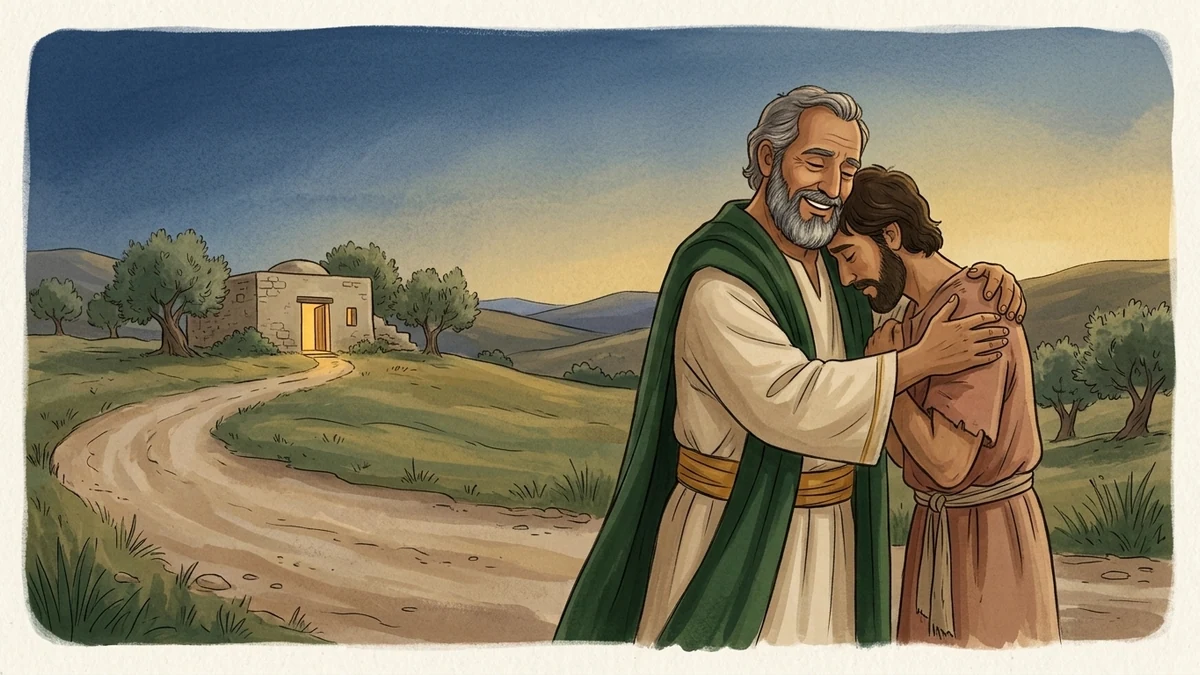
“So he got up and went to his father. But while he was still in the distance, his father saw him and was filled with compassion. He ran to his son, embraced him, and kissed him. The son declared, ‘Father, I have sinned against heaven and against you. I am no longer worthy to be called your son.’ But the father said to his servants, ‘Quick! Bring the best robe and put it on him. Put a ring on his finger and sandals on his feet. Bring the fattened calf and kill it. Let us feast and celebrate. For this son of mine was dead and is alive again! He was lost and is found!’ So they began to celebrate.”, Luke 15:20-24 (Berean Standard Bible, BSB)
Of all the sorrows that can enter a family, few cut as deep as watching a child choose a path far from faith and the safety of home. It is not a grief with a neat closing date; it is an open ache that returns in empty chairs at Sunday dinner, conversations cut short, and anxious silence whenever the phone rings late at night.
Parents who spent years reading Scripture, praying at bedtime, and trying their best to raise their children often find themselves pulled toward two opposite temptations. The first is paralyzing guilt, the belief that every past mistake explains the present distance. The second is emotional hardening, trying to protect a bruised heart by closing the door inside, telling yourself you have done all you could and refusing to hurt anymore.
It is right into that torn heart, caught between longing, fear, and frustration, that Jesus spoke the parable of Luke 15. This 35-minute study invites your household to read Luke 15:20-24 through first-century eyes and discover the rare balance of the biblical Father: one who does not block the consequences of leaving, yet never stops watching the road for a return.
The quiet wound inside the house
In everyday home life, a child’s drifting rarely starts with a dramatic speech at the front door. More often it takes shape gradually: fading interest in family conversations, shifting values, friendships that normalize shortcuts, brief replies, and emotional distance. Even when a child still lives under the same roof, parents can sense an ocean widening between the bedroom and the living room.
That distance also strains other relationships at home. A husband and wife often disagree on how to respond: one leans toward firm confrontation, demanding immediate change; the other leans toward smoothing everything over to avoid losing contact. Siblings watch the tension and sometimes nurse quiet resentment when every family conversation seems to orbit around the one who walked away.
In such a charged climate, a shallow reading of Luke 15 creates confusion. Some assume welcoming means pretending nothing happened; others think firmness requires coldness until a child earns back trust. Scripture, however, models a posture far stronger and more demanding than either extreme.
The scandal of grace in Luke 15: historical context and exegesis
To feel the full shock of Luke 15:20-24, we have to remember who was listening to Jesus. The chapter opens with sharp tension: tax collectors and sinners were gathering around Christ to hear Him, while Pharisees and scribes grumbled that He welcomed sinners and ate with them (Luke 15:1-2). In response, Jesus told three linked stories about what was lost and found: a sheep, a coin, and a son.
In first-century Jewish society, a younger son asking for his share of the estate while his father was still alive (v. 12) was an astonishing insult. It was nearly equivalent to wishing his father dead so he could cash out early. Worse still, he turned family land into silver, left for a distant Gentile region, and wasted everything until he ended up feeding pigs, the most unclean animal under Jewish law.
Only when hunger and ruin met him at rock bottom did he come to his senses and decide to go back, rehearsing a humble speech to ask merely for a place among the hired workers (v. 17-19). That sets the stage for Luke 15:20-24, packed with details that startled Jesus’ original listeners.
First, “while he was still in the distance, his father saw him and was filled with compassion.” You do not spot a lone traveler far down the road by accident; you see him because you keep watching the horizon. The father had never erased his son from memory. And the Greek word for compassion (splagchnizomai) points to deep, visceral mercy felt in the core of one’s being.
Second, “He ran to his son, embraced him, and kissed him.” In the ancient Mediterranean world, a respected elderly patriarch never ran in public. Running required lifting a long robe and exposing his legs, which was considered undignified. By sprinting down the village road before neighbors could surround and shame the young man, the father absorbed public humiliation onto himself to shield his son.
Third, look closely at the exchange in verses 21 and 22. The son begins his honest confession: “Father, I have sinned against heaven and against you. I am no longer worthy to be called your son.” He offers no excuses and does not blame his upbringing. Yet before he can finish the last line of his rehearsed speech about becoming a hired hand, the father cuts in and commands three concrete signs of restoration: “Quick! Bring the best robe and put it on him. Put a ring on his finger and sandals on his feet.”
Every item carried unmistakable weight. The best robe (likely the father’s own festive garment) covered rags of shame and announced forgiveness before the whole household. The signet ring restored trust and family authority. Sandals marked the standing of a free son, because servants walked barefoot. The feast with the fattened calf (v. 23-24) sealed the return of someone who had been spiritually dead and was alive again. Notice how the father does not place the young man on probation at the door to prove his sincerity for six months; instead, grace welcomes him home first so that real transformation can grow inside restored relationship.
The quiet warning in verse 25
Chapter 15 of Luke runs 32 verses and does not end at the banquet in verse 24. Right away, the older brother steps onto the page:
“Meanwhile the older son was in the field, and as he approached the house, he heard music and dancing.”, Luke 15:25 (Berean Standard Bible, BSB)
The older son’s reaction is vital for balanced family theology. He worked in the field, obeyed rules, and never left home, yet he carried a bitter spirit that treated serving his father like joyless slavery. When his broken brother came home, the older son refused to walk through the door.
This warns parents and siblings who remain faithful in church against a subtle danger: it is possible to defend moral truth while closing your heart to mercy. Notice that the father in the parable steps outside twice, first to embrace the rebellious son returning in shame, and then to plead with the dutiful son hardened by pride.
The harmony of Scripture on hope and endurance
No household prays for years over a wandering child without feeling peace grow thin at times. That is why the Apostle Paul reminds us that the Scriptures were preserved specifically to steady our endurance when human strength runs dry:
“For everything that was written in the past was written for our instruction, so that through endurance and the encouragement of the Scriptures, we might have hope.”, Romans 15:4 (Berean Standard Bible, BSB)
Luke 15 fulfills that exact purpose. It does not promise short timelines or guarantee there will be no pigpens along the way, but it reveals the heart of God. The Lord loves our children more deeply than we ever could, and He knows how to use even the bitter fruit of poor choices to awaken homesickness for the Father’s house.
Four pastoral postures for parents and family members
- Do not confuse steady love with hurried rescue. Notice that the father in Luke 15 did not travel to the distant country to pay off his son’s debts or shield him from hunger. Trying to spare an adult child from every natural consequence of destructive choices often delays the moment they come to their senses. Love deeply, pray without ceasing, and let reality do its sobering work when needed.
- Keep the bridge of relationship free from contempt. If every phone call or visit turns into a lecture, interrogation, or sharp remark, the road back looks bolted shut. Hold fast to Gospel truth without losing warmth in how you speak. Let them know that when their heart turns back toward God, they will meet open arms rather than a merciless courtroom.
- Unite as husband and wife in shared intercession. A wandering child often divides parents between guilt and mutual blame. Talk openly as a couple about your fears, forgive past parenting mistakes without tearing each other down, and pray together regularly, placing that child’s future in the Lord’s hands.
- Guard the hearts of those still at home. Do not let grief over one distant child starve your spouse or other children of presence, joy, and care. The entire household needs to taste the Father’s grace rather than living solely around one crisis.
Complete 35-minute family study and meditation guide
- Attentive Scripture reading (10 min): Read Luke 15:11-32 aloud together so you see the full portrait of both sons and the father. Notice how differently the father responds to each son’s struggle.
- Honest conversation and heart check (15 min): Talk openly about how your family responds to loved ones who have drifted from faith or stumbled badly. Does your table lean more toward patient intercession or bitter judgment?
- Focused prayer and weekly step (10 min): Pray by name for children, siblings, or relatives who are far from Christ right now. Choose one simple, affectionate outreach for this week with no lectures attached, reflecting the steady heart of the Father.
Frequently Asked Questions (FAQ)
Was the father in Luke 15 being permissive when he ran to meet his son?
No. The father did not rescue the son from the distant country or fund his reckless living; he allowed natural consequences to awaken repentance. Yet when his son returned broken, the father welcomed him without public humiliation and restored his place as a son.
What is the meaning of the robe, the ring, and the sandals in Luke 15:22?
In first-century Jewish culture, the best robe signified honor and public forgiveness, the signet ring represented family authority and belonging, and sandals marked the status of a free son, since hired servants went barefoot.
Why did Jesus include the older brother at the end of Luke 15?
To show that someone can stay physically inside the house while remaining far from the Father's heart. Verse 25 warns faithful households against religious coldness that resents grace shown to someone who failed.