
Ebenezer, Thus Far the Lord Has Helped Us: The Power of a Grateful Memory
Bible study on 1 Samuel 7:12 (35 min) about grateful memory and maturity: how the stone of Ebenezer strengthens a family's faith for the road ahead.
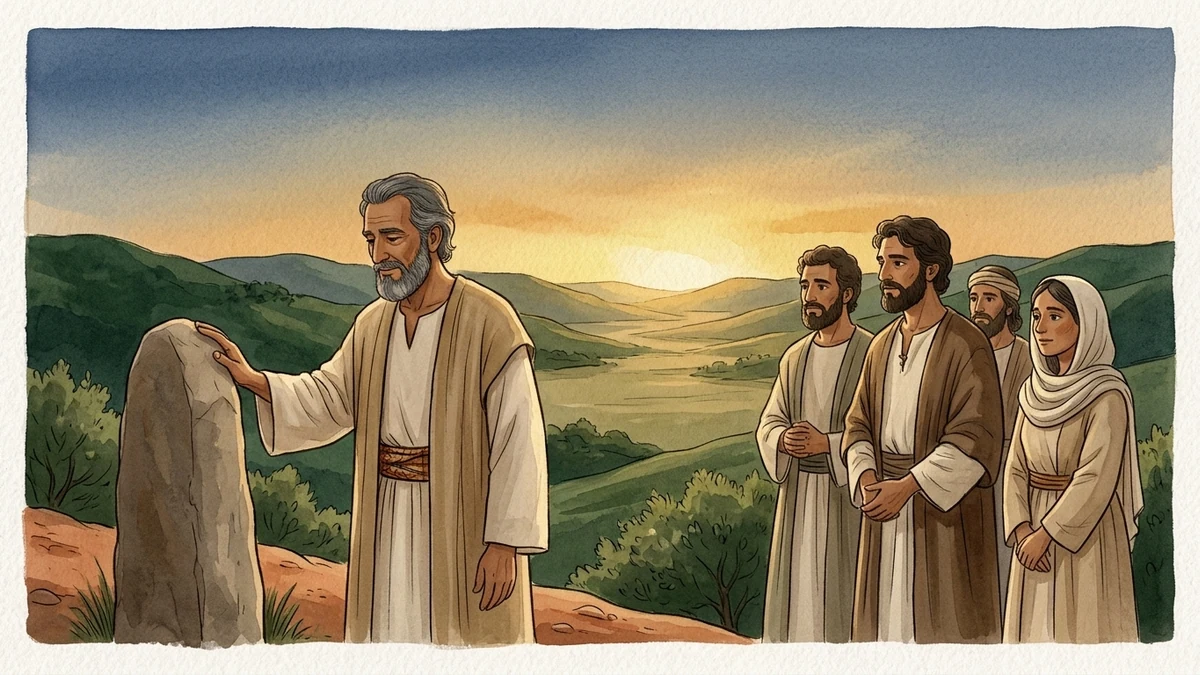
“Afterward, Samuel took a stone and set it up between Mizpah and Shen. He named it Ebenezer, saying, “Thus far the LORD has helped us.””, 1 Samuel 7:12 (Berean Standard Bible, BSB)
1. When One Chapter Closes and the Heart Needs Steadiness
There are seasons in the life of a family when time itself feels heavier than usual. It might be a wedding anniversary that invites a couple to look back across twenty or thirty years together, the morning the youngest child moves out, a cross-country relocation, stepping into retirement, or emerging from a long medical trial. At turning points like these, two currents often pull at the heart at once: tenderness toward everything that has passed and quiet apprehension about what has not yet taken shape.
During the busiest years of raising children and building a livelihood, there is rarely room to glance in the rearview mirror. Bills get paid, surprises get handled, sleepless nights are endured, and life moves forward on sheer momentum. The trouble is that when the pace finally slows and we look back, we can easily notice only the wear and tear of past battles, the mistakes we wish we had avoided, or the losses that still ache. Without a spiritual reading of our own history, memory becomes an archive of fatigue rather than a wellspring of courage.
Into that exact pause steps the scene of 1 Samuel 7:12. Before Israel takes its next step forward, the prophet Samuel asks an entire nation to look back, recognize where their help came from, and mark the ground with a stone.
2. The Dramatic Backdrop of 1 Samuel 7: From Shame to Restoration
To feel the full weight of the word Ebenezer, we have to turn back three chapters in the biblical narrative. In 1 Samuel 4, Israel was sinking into deep spiritual decay. Eli’s sons were corrupting worship at the tabernacle, leadership had grown weak, and Philistine armies were pressing the border. After losing an initial skirmish, Israel’s elders came up with a superstitious shortcut: they brought the ark of the covenant out of Shiloh into the camp, expecting the sacred chest to force a victory on its own without repentance or obedience.
The outcome was catastrophic. Thirty thousand soldiers fell, Eli’s sons died, the Philistines captured the ark, and the very campsite became synonymous with humiliation. And what was that place called in 1 Samuel 4:1? Ebenezer.
Twenty years passed after that disaster. Even after God sent plagues that forced the Philistines to return the ark, it sat quietly in Kiriath-jearim while Israel remained divided by idolatry and foreign oppression. Change only began when the whole house of Israel lamented after the Lord, and Samuel spoke plainly in 1 Samuel 7:3: if their return was genuine, they had to put away foreign gods and serve the Lord alone.
Chapter 7 records a visible turning of the heart. The people gathered at Mizpah, fasted, poured out water before the Lord in contrition, and confessed, “We have sinned against the LORD.” There were no shortcuts and no religious talismans. When the Philistine rulers heard about the assembly at Mizpah, they marched up to crush Israel while the people were gathered in prayer. Israel’s reaction was deeply human: they were afraid and begged Samuel not to stop crying out to the Lord for them.
As Samuel offered a young lamb as a burnt offering and prayed, the Philistines drew near for battle. The rescue did not come from Israel’s military strategy, but from heaven: the Lord thundered with a mighty sound that day against the Philistines and threw them into such confusion that they were routed before Israel.
Immediately after that turning point, Samuel took a stone, set it between Mizpah and Shen, and named it Ebenezer, “stone of help.” The very name that in chapter 4 marked shame, defeat, and shallow religion was redeemed in chapter 7 as a monument of grace and deliverance. The past was not erased; it was transformed. The next verse confirms how far that divine intervention reached:
“So the Philistines were subdued, and they stopped invading the territory of Israel. And the hand of the LORD was against the Philistines all the days of Samuel.”, 1 Samuel 7:13 (Berean Standard Bible, BSB)
Two details from that gathering at Mizpah deserve closer attention because they speak directly to a family walking through long seasons of waiting. The first is the act of pouring out water before the Lord (1 Samuel 7:6). Just as water poured onto dry ground cannot be scooped back up, Israel was admitting that it had no hidden reserve of strength left to bargain with; the people emptied themselves before God without holding anything back. The second detail is the burnt offering of a young lamb offered whole by Samuel while the enemy was already advancing up the ridge (vv. 9-10). Instead of cutting prayer short to scramble for last-minute defenses, the prophet stayed at the altar until heaven answered.
For many households, the gap between chapter 4 and chapter 7 feels painfully long. Twenty years is not twenty days. Some couples have prayed for decades for a prodigal child, for the rebuilding of trust after a deep wound, or for relief from a financial strain that seemed endless. 1 Samuel 7 shows that waiting years are never wasted years once the heart finally turns back to the Lord with honesty. God did not lose track of the story during the quiet decades; He was preparing the ground for a deliverance no one could mistake for coincidence.
3. What the Stone of Ebenezer Teaches About Our Own Story
The declaration “Thus far the LORD has helped us” carries rich theology for anyone navigating mature years and family transitions.
First, the phrase “thus far” honors the fact that the road has had distance, steep climbs, and hard bends. Biblical faith never asks us to pretend the past decades were effortless. Samuel did not claim Israel won on its own, nor did he minimize the twenty years of oppression leading up to Mizpah. Recognizing God’s help means admitting there were stretches where we lacked the wisdom, money, or stamina to move forward alone. Every financial storm weathered, every long night beside a sick bed, every marital reconciliation that once looked out of reach belongs inside that “thus far.”
Second, the subject of the sentence corrects our habit of self-reliance. It was not a couple’s cleverness, good timing, or sheer grit that carried a household to this day. The Lord helped. In Hebrew, the phrasing points to active, timely assistance right in the middle of pressure. When a family owns that truth, pride softens and anxiety loosens its grip, giving way to peace. If God sustained us up to this mile marker, He has not lost the strength to carry us through the next one.
Third, a memorial looks forward just as much as it looks backward. Samuel did not set up the stone merely to celebrate one bright afternoon; he planted it on a traveled road so that in the years ahead, parents and children walking between Mizpah and Shen would ask what that stone meant. Grateful memory disciples the next generation. The Apostle Paul highlights this same enduring purpose when speaking of Scripture itself:
“For everything that was written in the past was written for our instruction, so that through endurance and the encouragement of the Scriptures, we might have hope.”, Romans 15:4 (Berean Standard Bible, BSB)
Remembering is not living trapped in yesterday. In Scripture, remembering means gathering spiritual fuel to cultivate endurance, encouragement, and steady hope before an unknown tomorrow.
4. Four Practical Movements to Raise Your Ebenezer Today
Step 1: Take an honest inventory of the road traveled
Set aside thirty unhurried minutes this week, alone or with your spouse, with a notebook in hand. Instead of listing only what went wrong or what still needs fixing, write down five concrete moments from recent years when your household needed rescue and God answered. Include quiet mercies that were easy to miss at the time: a job that opened at the last hour, a word that prevented a rift, an unexpected recovery.
Step 2: Name the places of old defeat that God has redeemed
Just as Ebenezer shifted from a site of shame to a monument of grace, many families carry memories of past missteps, hasty choices, or seasons of spiritual drift. Acknowledge before God where repentance and change took root. Thank Him that His mercy not only forgave the failure, but rebuilt the home on steadier ground.
Step 3: Share the memorial with children: grandchildren: or close friends
Do not keep God’s faithfulness locked inside private journals. Around the dinner table or on a family call, tell younger loved ones one specific story of how the Lord provided or protected you during a difficult stretch. When children hear parents say, “Thus far the Lord has helped us,” they learn that faith is not Sunday theory, but solid ground for real life.
Step 4: Place the next season on the altar of trust
Before finalizing plans for the coming months, whether retirement, a move, a new role, or a budget shift, pray aloud declaring that the same God who brought your family this far remains in charge of the next chapter. Replace the fearful question “what if everything falls apart?” with the quiet certainty “the One who helped us thus far will walk with us still.”
5. Family Study and Meditation Guide (35 Minutes)
If you would like to walk through this study during a longer devotional time with your spouse or family, follow this unhurried rhythm:
- Reading and Context (10 min): Read 1 Samuel 7:1-13 aloud together. Notice how sincere repentance and prayer come right before the deliverance in verse 12.
- Circle of Grateful Memory (15 min): Each person shares at least one moment from the past year or past decade when they clearly saw God’s care for the family. If children or teens are present, help them recall specific situations you walked through together.
- Prayer of Dedication for the Next Chapter (10 min): Give thanks for every memory shared and place the household’s upcoming season (plans, health, decisions, and relationships) before God, closing with a joint reading of Romans 15:4.
Frequently Asked Questions (FAQ)
What does the name Ebenezer literally mean in 1 Samuel 7:12?
Ebenezer comes from the Hebrew 'Eben ha-Ezer', meaning 'stone of help'. Samuel set up this monument between Mizpah and Shen right after the victory over the Philistines so Israel would never forget that deliverance came solely from the Lord.
Why is the location of the Ebenezer stone so significant in 1 Samuel?
Back in 1 Samuel 4, Israel suffered two devastating defeats by the Philistines near Ebenezer when they treated the ark of the covenant like a lucky charm without repentance. Years later in 1 Samuel 7, after the people humbled themselves and prayed at Mizpah, God granted victory in that same region, turning a place of shame into a memorial of grace.
How can a family build a practical habit of grateful memory based on 1 Samuel 7:12?
A family can keep a gratitude journal or memory box recording answered prayers, unexpected provisions, and quiet rescues throughout the year. Reading those entries before major decisions or life transitions renews trust in God's care.