
We Do Not Grieve Like the Rest Who Have No Hope
In-depth Bible study on 1 Thessalonians 4:13-14 about comfort in grief: in Christ, sorrow is real and honest, yet it never ends in despair because of the resurrection.
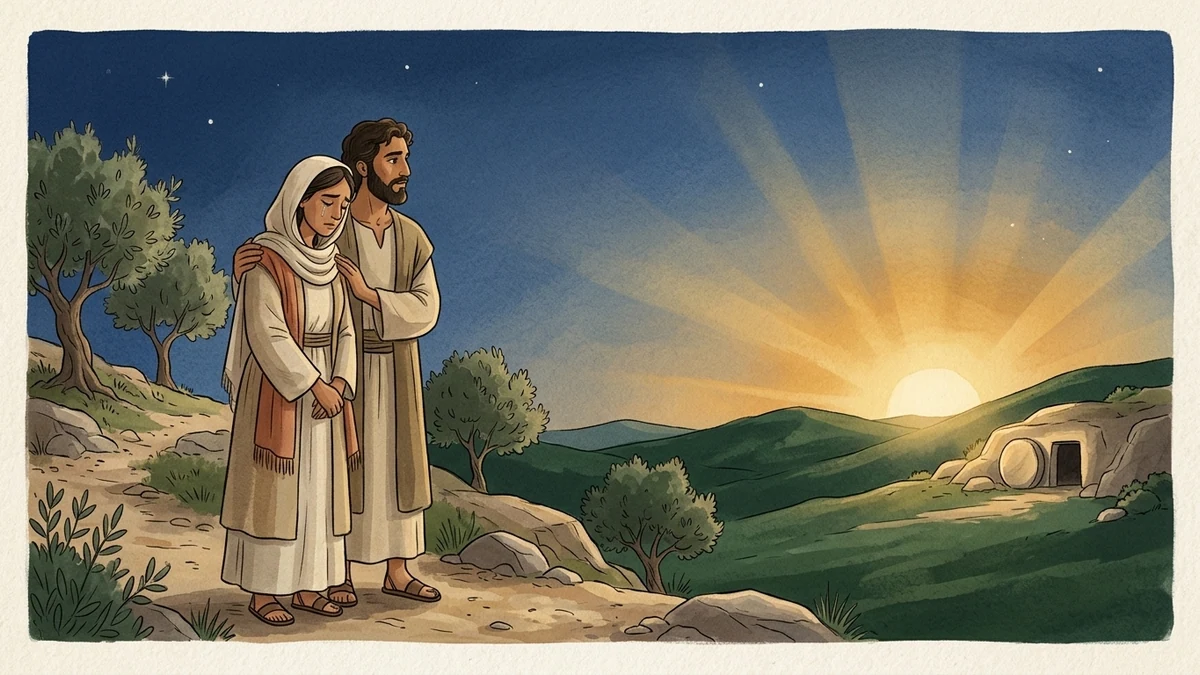
“Brothers, we do not want you to be uninformed about those who sleep in death, so that you will not grieve like the rest, who are without hope. For since we believe that Jesus died and rose again, we also believe that God will bring with Jesus those who have fallen asleep in Him.”, 1 Thessalonians 4:13-14 (Berean Standard Bible, BSB)
The ache of absence and the questions that linger
When someone we love leaves this life, the pain rarely ends at the cemetery gates. It spreads across the following months like a quiet tide. You feel it in the reflex to look for their face in a crowded room, in the phone that will never ring with that familiar voice again, and in birthdays or anniversaries that now arrive with a tightness in your chest.
Inside a Christian home, that longing often brings a delicate inner tension. On one hand, there is genuine doctrinal conviction that God is sovereign and that your loved one is safe. On the other hand, there is bruised human emotion, the physical fatigue of mourning, and sometimes a quiet fear that weeping too much looks like a lack of faith. Spouses sometimes avoid mentioning the person’s name so they will not upset each other; parents sometimes hide their tears from their children to appear steady.
1 Thessalonians 4:13-14 steps directly into that tender space. It was not composed in a detached academic study far removed from human sorrow. Paul wrote it to a young church that had just buried some of its first members and was overwhelmed with worry. This in-depth guide is designed so that you, alone, with your spouse, or together as a family, can take an unhurried look at the foundation of Christian hope in the face of death.
The world of Thessalonica: young believers facing their first graves
To feel the pastoral weight of Paul’s words, we have to step back roughly twenty years after the resurrection of Jesus. During his second missionary journey, the apostle arrived in Thessalonica, a bustling port city and the capital of the Roman province of Macedonia. There he preached the gospel intensely for only a few weeks before violent opposition forced him to leave in a hurry (Acts 17:1-10).
The new converts were left behind as a small flock surrounded by a hostile pagan culture. When Paul taught them about the glorious return of Christ, many of these believers expected Jesus to come back within their own lifetime. Months passed, persecution pressed in, and several members of the congregation grew ill or died.
Standing beside those fresh graves, a painful question gripped the church: What happens now? Have our relatives and friends who died missed the Lord’s arrival? Will they be left out of the great gathering when Christ returns?
Around them, the surrounding culture offered no comfort. In the first-century Greco-Roman world, mourning was often marked by bleak finality. Surviving tomb inscriptions from that era carry stark lines carved in stone: “I was not; I was; I am not; I do not care,” or “Farewell forever; we shall never meet again.” Pagan funerals frequently featured frantic, inconsolable wailing precisely because the culture saw death as an unbreakable wall.
To steady these anxious hearts and distinguish their sorrow from the despair of the ancient world, Paul sent his first letter to the church in Thessalonica.
What Paul says: and what he never says
The opening line of verse 13 deserves slow, attentive reading: “Brothers, we do not want you to be uninformed about those who sleep in death, so that you will not grieve like the rest, who are without hope.”
Notice the apostle’s remarkable balance. He does not write, “so that you will not grieve.” Scripture never commands the suppression of sorrow. In John’s Gospel, the Son of God Himself weeps outside the tomb of Lazarus (John 11:35), even while knowing He would raise His friend minutes later. Tears at a graveside are the healthy response of love recognizing that death is an intruder in God’s good creation.
The contrast Paul draws is not between “smiling Christians” and “weeping pagans.” The contrast is between two kinds of weeping: the grief of those who mourn without a horizon, and the grief of those who mourn anchored to a promise.
The Greek word Paul uses for “those who sleep in death” literally means “those who are falling asleep.” This phrasing is not a polite euphemism meant to soften an uncomfortable topic, nor does it teach that the soul vanishes or loses awareness after death. Elsewhere, the very same apostle writes that to be away from the body is to be at home with the Lord (2 Corinthians 5:8; Philippians 1:23).
When the New Testament calls a believer’s death “sleep,” it refers to the physical body laid in the ground. Just as no one lies down to sleep expecting never to wake again, the Christian’s body rests temporarily until the morning of resurrection. That single metaphor restores peace to a grieving household: we are not looking at permanent extinction, but at an interval kept under God’s watch.
The historical anchor of our comfort
In verse 14, Paul grounds our consolation not in vague wishes about the immortality of the soul, but in a public, historical event:
“For since we believe that Jesus died and rose again, we also believe that God will bring with Jesus those who have fallen asleep in Him.”
Watch the deliberate shift in vocabulary. When speaking of Jesus, Paul uses the stark verb: died. Christ did not gently “drift off to sleep.” He tasted the full rigor of death, bearing the curse of sin and the abandonment of the cross. When speaking of believers, however, Paul returns to the quiet image of sleep: those who have fallen asleep in Him. Because the Savior met death head-on and conquered it on the third day, death lost its power to hold anyone who belongs to Him.
In the original Greek, the phrase translated “since we believe” (ei gar pisteuomen) does not express doubt; it states an established reality. Because the death and resurrection of Christ are true, the coming reunion is equally certain. The Head cannot rise and leave the body behind in the dust.
Immediately afterward, the apostle reinforces this certainty with authority received directly from the Lord:
“By the word of the Lord, we declare to you that we who are alive and remain until the coming of the Lord will by no means precede those who have fallen asleep.”, 1 Thessalonians 4:15 (Berean Standard Bible, BSB)
Not one child of God will be forgotten in a dark corner of history. When Christ returns, the very first to be raised in glory will be those whose bodies rest in the earth, and together with believers still living, they will form one unbroken household before the Lord.
The whole Bible points toward patient endurance
Paul’s pastoral care here echoes the wider purpose of all Scripture. Writing to the church in Rome, he explains why God preserved so many records of His faithfulness across the centuries:
“For everything that was written in the past was written for our instruction, so that through endurance and the encouragement of the Scriptures, we might have hope.”, Romans 15:4 (Berean Standard Bible, BSB)
The word “endurance” points to steady perseverance under a heavy, prolonged load. Grief is almost always a prolonged load. It demands stamina for ordinary Tuesdays, long after the initial shock fades and the reality of an empty chair settles into the house.
It is along that long stretch of road that God’s Word does its quiet work. It does not promise instant numbness for your longing, yet it gives three sturdy supports that reshape the emotional climate of a home.
First, it frees the household from artificial silence. If death does not hold the final word, we can speak warmly and gratefully about the person who died, recalling their faith, their laughter, and the lessons they left behind, without turning their name into a forbidden subject at the dinner table.
Second, it guards the heart from bitterness. Unprocessed grief easily hardens the spirit or turns into quiet anger toward God. Looking at the cross and the empty tomb reminds us that God is no distant spectator of human suffering; in Christ, He entered death itself to break it from the inside.
Third, it redirects our eyes toward the future. The world insists that everything we shared with the person we love lies strictly in the past. The gospel declares that for those who are in Christ, our best meeting is still ahead.
Living this hope inside the ordinary rhythms of home
Deep theology fulfills its purpose when it reaches the kitchen table, the living room, and the quiet minutes before sleep. How can a grieving household live out 1 Thessalonians 4:13-14 in concrete ways?
Make room for memory with gratitude and truth
Do not rush to pack away every photo or avoid every reminder in hopes of hurting less. Instead, set aside natural moments, perhaps a Sunday meal, to thank God for the life of the person who passed and the good marks they left on your family. When younger family members hear parents speak calmly about heaven and the resurrection, they learn more lasting theology than from a dozen formal lessons.
Pray honestly on the days longing hits hardest
When a milestone arrives, such as a birthday or a holiday season, do not pretend it is an ordinary day. Gather your spouse or children, acknowledge aloud that the absence hurts today, read verses 13 and 14 of 1 Thessalonians 4 together, and ask the Holy Spirit for the comfort only He knows how to give.
Let your own comfort become care for someone else
Many households that have walked through bereavement gradually notice a sharper sensitivity to other people’s hidden pain. A quiet visit, a warm meal left on a porch, or a brief text on a difficult anniversary carries rare weight when it comes from someone who has wept the same loss. Verse 18 of this chapter closes Paul’s teaching with a practical charge: encourage one another with these words. Christian hope was never meant to be hoarded in private; it grows stronger when it is shared.
Care for your tired body as well
Grief drains physical reserves. Broken sleep, shifts in appetite, and sudden exhaustion are normal parts of adjusting to loss. Respect your limits at home, avoid making rushed financial or major life decisions in the early months, and allow trusted friends from your local church to step in with practical help when they offer.
Study and meditation guide for this week
Set aside an unhurried block of time, free from phones and background noise, to walk through the passage slowly:
- Slow reading (10 minutes): Read 1 Thessalonians 4:13-18 aloud from start to finish. Notice how often the apostle ties our hope directly to the person of Jesus (“in Him,” “with Jesus,” “to meet the Lord”).
- Honest reflection (15 minutes): Ask your own heart, or talk through together as a couple: Have I given myself permission to weep before God without guilt? Where has longing tried to pull me into isolation from the people who love me?
- Practical step and prayer (10 minutes): Choose one simple action for this week, whether speaking openly with a child about the hope of the resurrection or sending a brief note of encouragement to someone else who is grieving. Close by praying together and placing tomorrow into the hands of the Lord of life.
Questions for personal or couple reflection
- In your daily routine lately, what is the practical difference between “grieving with real pain” and “grieving without hope”?
- How does the historical certainty that “Jesus died and rose again” steady your mind when you try to picture the future without your loved one?
- Is there a gentle conversation about your loss that your household has been postponing and needs to have this week?
- Who in your circle of friends or church family needs a simple, honest word of comfort today from someone who understands the ache of goodbye?
Frequently Asked Questions (FAQ)
Is Paul forbidding Christians from crying or feeling sorrow in grief?
Not at all. The apostle does not say 'do not grieve,' but 'do not grieve like the rest, who have no hope.' Jesus Himself wept at the tomb of Lazarus. Biblical faith acknowledges the pain of separation while separating it from the hopeless despair of those who do not know Christ.
Why does the New Testament use the word 'sleep' for believers who have died?
In Scripture, 'sleep' is a tender metaphor for the believer's physical body resting in death while awaiting the waking of the resurrection. It does not teach that the soul ceases to exist, but affirms that death has lost its permanence and terror for those in Christ.
What specific worry troubled the Thessalonian church behind 1 Thessalonians 4:13-15?
The new converts in Thessalonica feared that brothers and sisters who died before Jesus returned would miss out on the glory of Christ's coming. Paul writes to assure them that those who fell asleep in Jesus will not be left behind, for God will bring them with Him.