
The Prayer Offered in Faith Will Restore the One Who Is Sick
Bible study on James 5:14-16 about health, sickness, and healing: community prayer, honest confession, and God's restoring care when the body grows weak.
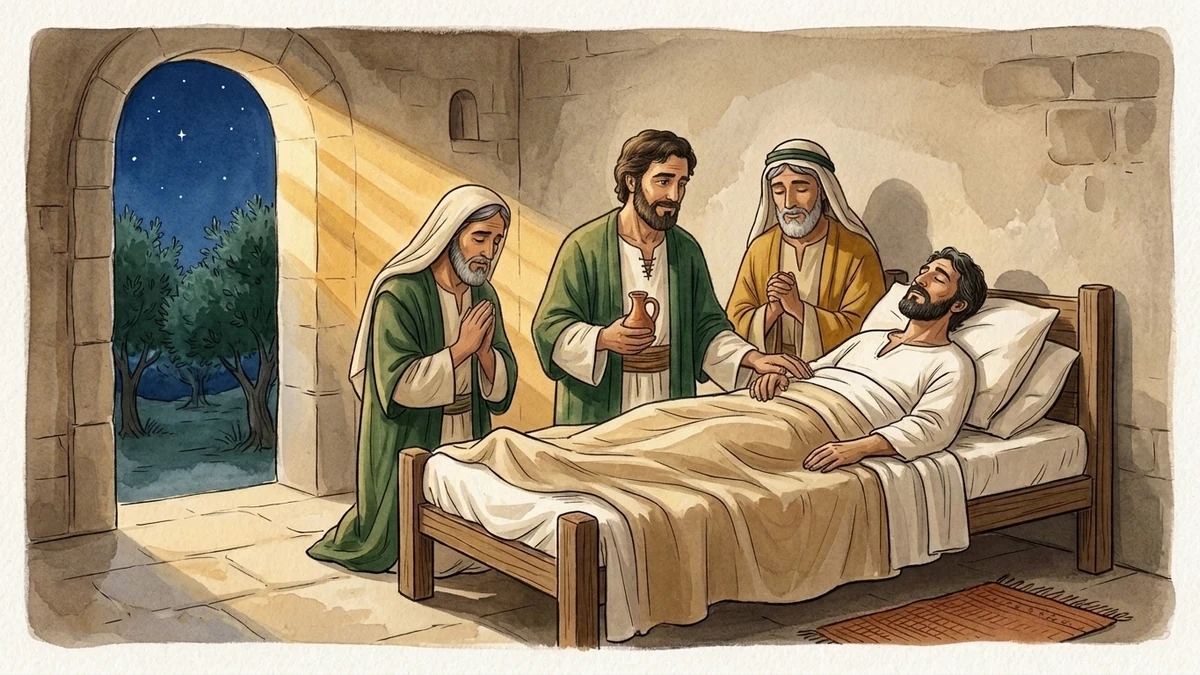
“Is any one of you sick? He should call the elders of the church to pray over him and anoint him with oil in the name of the Lord. And the prayer offered in faith will restore the one who is sick. The Lord will raise him up. If he has sinned, he will be forgiven. Therefore confess your sins to each other and pray for each other so that you may be healed. The prayer of a righteous man has great power to prevail.”, James 5:14-16 (Berean Standard Bible, BSB)
There is a particular kind of loneliness that has nothing to do with an empty house and everything to do with the quiet wall illness builds around a family. When a household walks through a prolonged sickness or a diagnosis that rearranges every plan, life outside keeps moving at full speed while time inside the bedroom slows to a crawl. Appointments pile up, check-in messages gradually fade after the first few weeks, and a quiet weight settles in that feels hard to explain to anyone who is not living it.
In many Christian homes, that isolation is deepened by an unspoken hesitation. People worry about sounding weak in faith, bothering church leaders with repeated requests, or admitting that their emotional reserves have run dry. A culture built on self-reliance trains us to present tidy versions of our lives, even when we are exhausted between lab results, prescriptions, and sleepless nights.
James 5:14-16 speaks directly into that quiet isolation. Jesus’ brother does not hand us a sterile formula or promise a life untouched by frailty. Instead, he starts with a real member of the congregation who is too weak to walk to the gathering and must call the elders into his own home. There, inside ordinary family walls, the gospel meets sickness through prayer, tangible care, forgiveness, and shared faith.
The Quiet Weight of Illness Inside a Home
Before examining the Greek phrasing of the passage, it helps to look honestly at what happens in a household when health breaks down. Sickness rarely stays confined to one part of the body. It stretches patience between husband and wife, unsettles children who sense unspoken tension, strains the budget, and surfaces old fears that busy weeks normally keep out of view.
Caregivers know a special kind of weariness: the pressure to appear calm so the sick loved one will not panic, while inner questions grow louder by the day. At the same time, the person who is ill often battles quiet guilt over needing help, missing work, or seeing fatigue on the faces of the people they love most.
In that atmosphere, spiritual isolation becomes a real danger. When a family pulls the curtains shut and decides to weather the storm alone, anxiety multiplies without perspective. Small worries swell into overwhelming dread at two in the morning. James points us in the opposite direction: the health of Christ’s body requires that the pain of one household be brought into the prayer and care of the church family.
The Context of James 5: Patience: Integrity: and Shared Prayer
To read James 5:14-16 faithfully, we need to see how it fits inside the final chapter of the letter. Chapter 5 contains 20 verses and opens with a sharp warning to wealthy oppressors who withheld wages from laborers (5:1-6). James then turns to believers enduring hardship under that pressure, calling them to patient endurance until the Lord’s coming, pointing to the prophets and the perseverance of Job (5:7-11).
After urging truthful speech in verse 12, James sketches a realistic portrait of Christian life across changing seasons in verse 13 and following:
- Is anyone in trouble? Let him pray.
- Is anyone cheerful? Let him sing praises.
- Is anyone sick? Let him call the elders of the church.
Notice the pastoral realism of that rhythm. Christian faith neither denies sorrow nor forces fake cheer; it directs every condition of the soul toward God. Yet when serious illness strikes, James adds an essential communal step. When weakness makes it hard to pray alone with clarity, the believer should not retreat into silence. He is to invite the spiritual shepherds of the local church into his home.
Looking closely at the biblical language
The Greek verb translated “is sick” (asthenei) describes genuine physical weakness or debility, someone lacking the strength to stand on their own. That is why the action begins with a humble initiative: “He should call the elders of the church.” The sick person opens the front door and admits need.
The elders come to do two things: pray over the sick person and anoint him with oil in the name of the Lord. In the ancient Mediterranean world, olive oil was widely used as a soothing medicinal treatment for wounds and aches, as seen in the parable of the Good Samaritan (Luke 10:34). At the same time, in apostolic practice (Mark 6:13), anointing with oil served as a visible sign of consecration, setting the moment apart for God’s sovereign work. James creates no rivalry between practical care and spiritual dependence; both are carried out “in the name of the Lord,” under the authority and character of Jesus Christ.
Verse 15 continues: “And the prayer offered in faith will restore the one who is sick. The Lord will raise him up.” Both verbs (sosei, to save or restore, and egerei, to raise up) carry physical weight as well as the broader sense of spiritual renewal and return to active fellowship. And the subject is unmistakable: it is not human technique or the status of the elders that raises the sick person up, but the Lord Himself.
Sickness: sin: and the freedom of confession
In the middle of verse 15, James adds a line that calls for careful reading: “If he has sinned, he will be forgiven.” That small word “if” matters deeply. Scripture rejects the cruel assumption that every illness is punishment for a specific sin. Jesus dismantled that error when asked about the man born blind (John 9:3), and the book of Job shows a righteous servant enduring severe bodily affliction without hidden guilt behind it.
Yet James also knows that body, conscience, and relationships are closely woven together. There are seasons when unconfessed sin, lingering bitterness at home, deceit, or quiet rebellion drains spiritual peace and fractures fellowship. When illness forces life to slow down, buried guilt often rises to the surface.
That is why verse 16 widens the circle: “Therefore confess your sins to each other and pray for each other so that you may be healed.” Confession here is not reckless public oversharing, but the mature willingness to own our wrongs before those we have hurt or with trusted believers, seeking reconciliation. Where forgiveness moves freely inside a home and church, guilt stops choking out prayer.
Elijah as a portrait of ordinary people praying
So that no one dismisses “the prayer of a righteous man” as something reserved for spiritual elites, James immediately points to an Old Testament prophet in the next verse:
“Elijah was a man just like us. He prayed earnestly that it would not rain, and it did not rain on the land for three and a half years.”, James 5:17 (Berean Standard Bible, BSB)
The phrase “a man just like us” (homoiopathes) literally means someone with the same human nature, emotions, and vulnerabilities. Elijah stood bold on Mount Carmel, yet shortly afterward collapsed under fear, exhaustion, and despair in the wilderness (1 Kings 19). What made his prayer effective was not superhuman stamina, but the faithfulness of the God he approached with persistent trust.
The Harmony of Scripture: Hope Anchored in God’s Word
When believers read strong promises like “the prayer offered in faith will restore the one who is sick,” an honest question often surfaces for anyone who has prayed fervently for a loved one and watched physical healing wait. How do we hold James 5 alongside Paul praying three times for his thorn in the flesh without its removal (2 Corinthians 12:7-9), or leaving Trophimus sick in Miletus (2 Timothy 4:20)?
The answer lies in reading all of Scripture together. God truly heals bodies today, sometimes in ways that astonish doctors, and we should ask boldly for healing. At the same time, the prayer of faith does not make us managers of God’s decrees; it places our loved ones into the hands of a Father whose wisdom reaches beyond this present life. Even when full bodily restoration waits for the resurrection, the Lord never fails to raise the weary spirit, forgive sin, and sustain a household with His presence.
The Apostle Paul summarizes this comforting purpose of Scripture in his letter to the Romans:
“For everything that was written in the past was written for our instruction, so that through endurance and the encouragement of the Scriptures, we might have hope.”, Romans 15:4 (Berean Standard Bible, BSB)
Holding James 5 and Romans 15 together protects a home from two extremes: the cynicism that stops praying altogether, and the harsh triumphalism that blames the sick person when recovery takes time. God preserved His Word to cultivate steady endurance, real comfort, and living hope.
Practical Steps to Live James 5:14-16 at Home
Bringing this passage into everyday family life calls for concrete choices in how we handle weakness at home and within our local congregation.
1. Trade proud isolation for the humility of asking for help
When an illness or heavy trial stretches on, resist the urge to hide behind polite answers out of shame or fear of being a burden. Reach out to your pastors, elders, or mature believers in your church. Inviting people of faith into your home to pray is an act of biblical obedience, not spiritual failure.
2. Pair responsible medical care with trusting prayer
There is no conflict between following a doctor’s treatment plan faithfully and asking the elders to anoint and pray over a sick family member. Medical wisdom reflects God’s common grace in creation, while prayer acknowledges that no medicine sustains life apart from the Creator’s hand.
3. Practice confession and reconciliation inside the household
Before looking only for outward relief, ask gently whether unspoken resentment, harsh words, or quiet distance has settled between spouses, parents, and children. Seeking forgiveness at home clears the spiritual air, restores warmth around the table, and strengthens family prayer.
4. Become a steady presence for other weary homes
Those who have felt the relief of shared prayer during dark weeks learn to notice loneliness in others. Dropping off a meal, helping with carpool for a family in treatment, or sitting quietly to pray in simple words puts James 5 into action without empty speeches.
Family Study and Prayer Guide
Set aside unhurried time this week, alone or with your household, to walk through these three steps:
- Attentive reading (10 minutes): Read all of James 5 aloud, noticing how the call to patient endurance (vv. 7-11) prepares the way for shared prayer and mutual care (vv. 13-18).
- Honest conversation (15 minutes): Talk together about where self-reliance has kept your home from asking for prayer or support. If any relational tension or unspoken guilt needs forgiveness, use this time to speak with grace and truth.
- Practical intercession (10 minutes): Choose one family in your church or circle of friends walking through sickness or isolation. Pray for them by name and decide on one concrete act of care you can offer them this week.
Frequently Asked Questions (FAQ)
Does James 5:14-15 guarantee instant physical healing every time elders pray?
James teaches genuine confidence in God's power to raise up the sick, while the broader witness of Scripture shows that healing unfolds according to God's sovereign wisdom (as seen in Paul's thorn in 2 Corinthians 12 or Trophimus in 2 Timothy 4:20). The prayer of faith is not a technique to force God's hand, but a trusting surrender that brings comfort, forgiveness, and restoration in God's way and timing.
Why does James connect prayer for the sick with forgiveness and confessing sins?
James deliberately uses a conditional phrase ('if he has sinned') because not every illness is caused by personal sin. Yet unconfessed sin, bitterness, and relational fractures drain spiritual peace. Mutual confession restores fellowship and clears barriers to prayer.
What is the meaning of anointing the sick with oil in James 5:14?
In the ancient Mediterranean world, olive oil was both a practical soothing remedy and a symbol of consecration and the Holy Spirit's presence. Pairing oil with prayer in the name of the Lord shows that practical care and dependence on God belong together.