
The Lord Goes Before You: He Will Never Leave You Nor Forsake You
Bible study on Deuteronomy 31:6-8 about loneliness and God's care: when a new chapter feels daunting, the Lord goes ahead and anchors us in His Word.
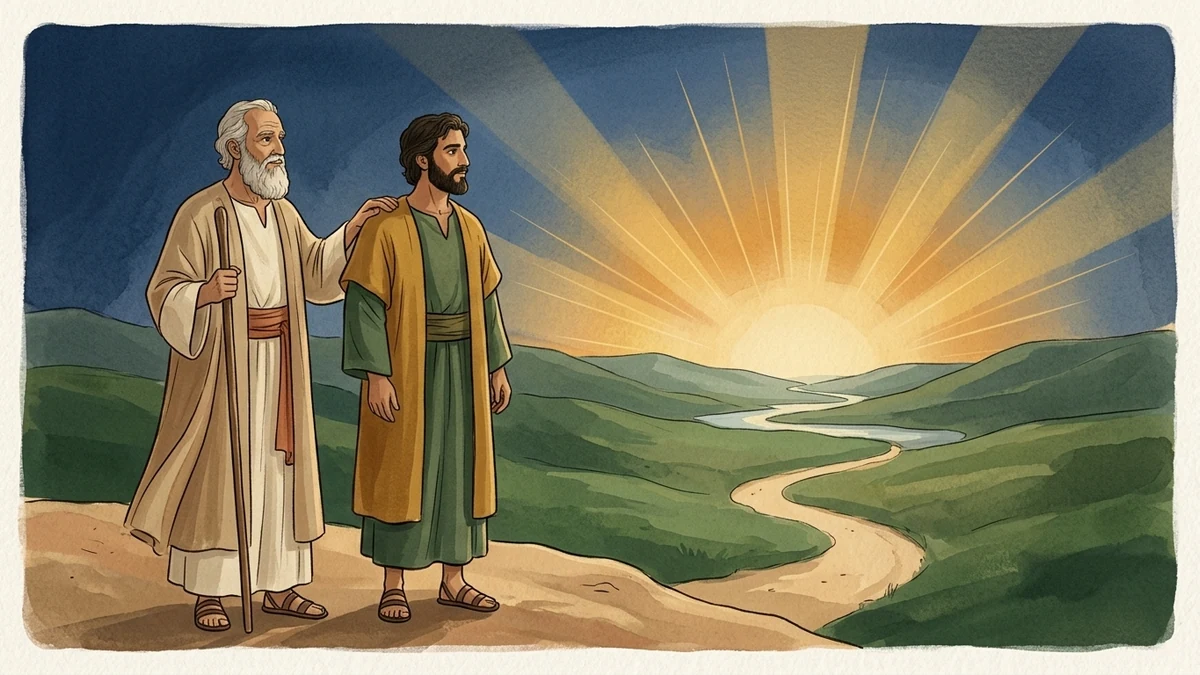
“Be strong and courageous; do not be afraid or terrified of them, for it is the LORD your God who goes with you; He will never leave you nor forsake you.” Then Moses called for Joshua and said to him in the presence of all Israel, “Be strong and courageous, for you will go with this people into the land that the LORD swore to their fathers to give them, and you shall give it to them as an inheritance. The LORD Himself goes before you; He will be with you. He will never leave you nor forsake you. Do not be afraid or discouraged.””, Deuteronomy 31:6-8 (Berean Standard Bible, BSB)
Every major transition carries an emotional cost we do not always talk about openly. It might be moving to a city where no one knows your name, stepping into a demanding role, watching a child leave for college, adjusting to widowhood, or suddenly carrying family decisions that used to rest on aging parents. On the outside, we handle the logistics; on the inside, there is often a quiet sense of stepping onto unfamiliar ground without backup.
That kind of transitional loneliness tends to surface right when old landmarks fade behind us and the new season has not yet settled into steady footing. Deuteronomy 31:6-8 speaks directly to a family standing in that gap. These words were not spoken in a calm, settled season, but on the exact border between a closing chapter and a responsibility that looked far too large for one person to carry.
The Quiet Weight of New Chapters Without a Safety Net
When we lose a trusted mentor or step out of a familiar routine, fear rarely comes only from the tasks ahead. Much of it comes from feeling exposed. Before, there was someone to call for advice, a predictable rhythm, or a circle of friends nearby. Now the phone rings less, expectations rise, and the quiet doubt about whether we will measure up returns each evening.
In many households, that weight stays hidden behind busyness. Husband and wife divide practical chores on autopilot while each quietly carries the uncertainty of the new stage. Other times, a young adult starting out or someone rebuilding after a loss misses having a steady voice say: you do not have to figure this out alone.
Scripture meets that fear with realism rather than slogans. God does not tell Joshua that crossing the Jordan will be effortless or that the cities ahead are small. Instead, He speaks straight to the root of human dread: the fear of being left on our own.
The Context of Deuteronomy 31: Passing the Torch at the Jordan
Chapter 31 of Deuteronomy contains 30 verses and captures one of the most solemn moments in the Pentateuch. Moses is 120 years old (31:2) and knows he will not cross the Jordan River with Israel. For four decades, he stood as the visible mediator between God and the nation, confronting Pharaoh, receiving the law at Sinai, and interceding in the wilderness. Now his voice is about to fall silent, and Israel must face fortified cities under a new leader.
Notice Moses’ twofold care in this farewell. First, in verse 6, he addresses the entire nation: “Be strong and courageous; do not be afraid or terrified of them.” Then, in verses 7 and 8, he calls Joshua forward in front of all Israel and repeats the same promise personally. God’s assurance covers both the whole household and the individual bearing the weight of leading into unknown territory.
Two Hebrew expressions in verse 8 stand out:
- “The LORD Himself goes before you”: God is not merely a companion walking beside us and reacting to surprises as they appear. He arrives in the new territory ahead of us, already aware of challenges we cannot yet see.
- “He will never leave you nor forsake you”: the first verb (raphah) pictures loosening one’s grip or letting go; the second (azab) means leaving behind or abandoning. The Lord pledges that He will neither lose His hold on His servant nor walk away mid-journey.
Right after this public charge, verse 9 records a crucial practical step:
“So Moses wrote down this law and gave it to the priests, the sons of Levi, who carried the ark of the covenant of the LORD, and to all the elders of Israel.”, Deuteronomy 31:9 (Berean Standard Bible, BSB)
The connection between verses 8 and 9 is deeply instructive. Joshua was not sent forward with emotional hype alone; he had the ark of the covenant and the written law entrusted to the priests and elders. Biblical courage never separates God’s presence from God’s Word lived out within a community.
Practical Ways to Walk Through Transitions at Home
Living Deuteronomy 31:6-8 during a major life shift calls for grounded habits that bring God’s promise into ordinary days.
1. Distinguish human loneliness from divine abandonment
Missing familiar faces, a trusted mentor, or a loved one who has passed is deeply human. The mistake is assuming that because visible support has thinned out, God has stepped back too. Even when an irreplaceable human chapter closes, just as Moses’ leadership ended for Joshua, the Lord remains unchanged.
2. Trade paralyzing fear for today’s obedience
Notice that “Be strong and courageous” did not require Joshua to map out the next ten years. He only needed to cross the river and take the next faithful step. When a new season feels overwhelming, focus on the faithfulness required today, trusting that God is already present in tomorrow.
3. Keep Scripture at the center of changing routines
During moves, job shifts, or family upheaval, Bible reading and prayer are often the first habits crowded out by fatigue. Verse 9 reminds us that Moses placed the written law right alongside the people as they entered the land. Setting aside ten quiet minutes morning or evening to read Scripture together keeps anxiety from setting the tone of the home.
4. Build fresh community in the new season
Even though God is our ultimate security, He placed Joshua inside a living community of priests, elders, and fellow tribes. If you have entered a new city or life stage, take the initiative to connect with a faithful church, invite someone for simple coffee, or ask mature believers to pray with you. God often answers transitional loneliness by placing new brothers and sisters along the road.
Questions for Family Reflection
Take a few unhurried minutes today to reflect or talk through these questions together:
- What transition are we walking through right now? Is there a recent change or new responsibility that has left someone in our home feeling unsupported or on edge?
- What has fear been whispering? Which future unknowns are stealing peace today, and how does the truth that “the LORD Himself goes before you” answer them?
- What anchor will we set this week? What simple habit of reading Scripture, praying together, or reaching out to church community can our household commit to starting today?
Frequently Asked Questions (FAQ)
What was happening in Israel's history when Moses spoke Deuteronomy 31:6-8?
At 120 years old on the border of the Jordan River, Moses was handing leadership over to Joshua before Israel entered the promised land. He encouraged the whole nation first (v. 6) and then addressed Joshua publicly (vv. 7-8), assuring them that God's presence would outlast Moses' life.
What does 'He will never leave you nor forsake you' mean in the original text?
The two Hebrew verbs convey that God will not loosen His grip out of weariness (raphah) or abandon His people along the way (azab). Even when human mentors or familiar supports step back, the Lord's faithfulness holds firm.
Why does Deuteronomy 31:9 immediately mention Moses writing down the law?
Because biblical courage is not built on fleeting emotion. God equips His people for new seasons with both His constant presence and His written Word preserved within the community of faith.